



Overview of Soda Ash Manufacturing Process
The soda ash manufacturing process operates on a large industrial scale and relies on highly controlled chemical reactions, precision equipment, and strict quality systems. Manufacturers design production plants to maximize yield, reduce energy consumption, and maintain consistent product purity.
Industrial facilities apply both synthetic and natural production routes, depending on raw material availability and cost efficiency.
Major Soda Ash Manufacturing Process Methods
Solvay process overview
The Solvay process remains one of the most widely used methods in global production. It uses brine, limestone, and ammonia to produce soda ash through controlled chemical reactions. Plants maintain strict temperature and pressure conditions to ensure stable output.
Table of Contents
ToggleNatural trona processing
Some manufacturers extract soda ash from trona ore. They crush, dissolve, and refine the ore before converting it into high-purity soda ash through calcination and crystallization steps.
Step-by-Step Soda Ash Manufacturing Process
Brine preparation stage
Manufacturers first prepare a purified salt solution. They remove impurities such as calcium and magnesium to ensure stable downstream reactions. This step ensures consistent chemical performance throughout the process.
Ammoniation process
Plants inject ammonia gas into the purified brine. This step increases the solution’s reactivity and prepares it for carbonation. Operators carefully control ammonia concentration for efficiency.
Carbonation stage
Carbon dioxide enters large carbonation towers where it reacts with ammoniated brine. This reaction forms sodium bicarbonate crystals. Engineers monitor temperature and gas flow to maintain high conversion rates.
Filtration and separation
Operators separate sodium bicarbonate crystals from the liquid mixture using industrial filtration systems. This step ensures solid recovery while recycling remaining ammonia-rich solution.
Calcination process
The soda ash manufacturing process continues with calcination. Manufacturers heat sodium bicarbonate in rotary kilns, breaking it down into soda ash, water vapor, and carbon dioxide. This stage defines final product quality and purity.
Drying and cooling
After calcination, producers dry and cool the soda ash. Controlled cooling prevents moisture absorption and maintains stable particle structure.
Equipment Used in Soda Ash Manufacturing Process
Carbonation towers
These tall vertical columns allow gas-liquid interaction. They play a central role in ensuring efficient conversion during carbonation.
Rotary kilns
Kilns handle high-temperature decomposition during calcination. They maintain consistent heat distribution to produce uniform soda ash.
Crystallizers
Crystallizers control the formation of sodium bicarbonate crystals. They ensure optimal size and shape for efficient filtration.
Chemical Reactions in Production
The soda ash manufacturing process depends on carefully balanced reactions between ammonia, carbon dioxide, and sodium chloride. Engineers optimize reaction conditions to increase yield and reduce waste.
Energy flow plays a critical role. Plants recover heat from calcination and reuse it in earlier stages to improve efficiency.
Quality Control in Soda Ash Manufacturing Process
Purity testing
Laboratories test final output for sodium carbonate concentration. High-quality production maintains strict impurity limits.
Particle size control
Manufacturers control grinding and crystallization parameters to ensure uniform particle size distribution.
Energy Efficiency Optimization
Modern plants integrate advanced heat recovery systems to reduce fuel consumption. Engineers also design closed-loop systems that recycle gases and minimize energy loss.
Process integration helps manufacturers streamline operations and reduce overall production costs.
Environmental Control Measures
Manufacturers implement emission control systems to reduce carbon dioxide and ammonia release. Scrubbers and recycling units capture gases and reuse them in production cycles.
Wastewater treatment systems ensure safe discharge or reuse within the plant.
Packaging and Storage
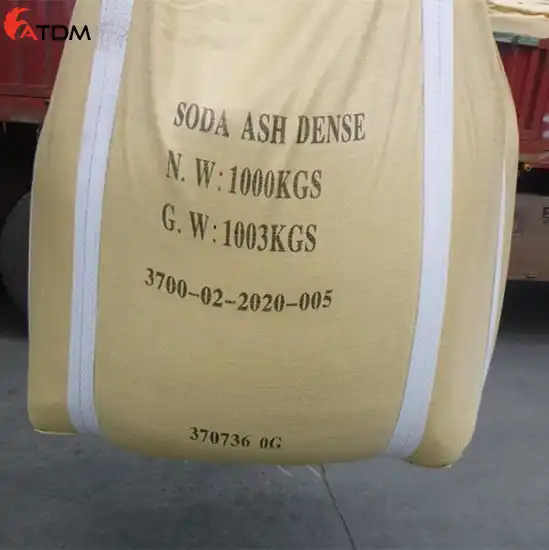
Producers store soda ash in moisture-proof silos. Automated systems handle bulk loading for shipping. Packaging lines fill industrial bags with precise weight control to ensure consistency.
Safety in Manufacturing Plants
Operators follow strict safety protocols due to high-temperature processes and chemical handling. Plants install monitoring systems to detect leaks, pressure changes, and gas imbalances.
Automation in Modern Plants
Advanced control systems manage the entire soda ash manufacturing process. Sensors track temperature, pressure, and chemical concentration in real time. Automation improves consistency and reduces human error.
Challenges in Soda Ash Manufacturing Process
Manufacturers face challenges such as energy consumption, raw material variability, and equipment scaling. They continuously improve process efficiency to reduce production costs.
Process Optimization Techniques
Engineers apply process simulation tools to improve yield. They adjust reaction conditions, optimize flow rates, and improve heat recovery systems.
Continuous improvement ensures stable production and competitive advantage.
Role of Suppliers in Supply Chain
Reliable raw material and chemical suppliers play an important role in production stability. Companies like ATDM supply high-quality soda ash that supports industrial applications across multiple sectors.
FAQs on Soda Ash Manufacturing Process
1. What are the main stages of the soda ash manufacturing process?
The process includes brine preparation, carbonation, filtration, calcination, and drying.
2. Which method is most commonly used?
The Solvay process remains the most widely used industrial method.
3. How is energy optimized in production?
Manufacturers use heat recovery systems and process integration techniques.
4. What equipment is essential in production plants?
Key equipment includes carbonation towers, rotary kilns, and crystallizers.
5. How do plants control product quality?
They use laboratory testing, particle size control, and automated monitoring systems.
6. Is automation important in modern production?
Yes, automation improves efficiency, safety, and consistency in output.
Conclusion
The soda ash manufacturing process relies on carefully controlled chemical reactions, advanced equipment, and modern automation systems. Every stage—from brine preparation to final drying—works together to produce high-quality output at industrial scale. With continuous improvements in efficiency, environmental control, and process optimization, manufacturers achieve stable production and consistent product quality for global markets.


