



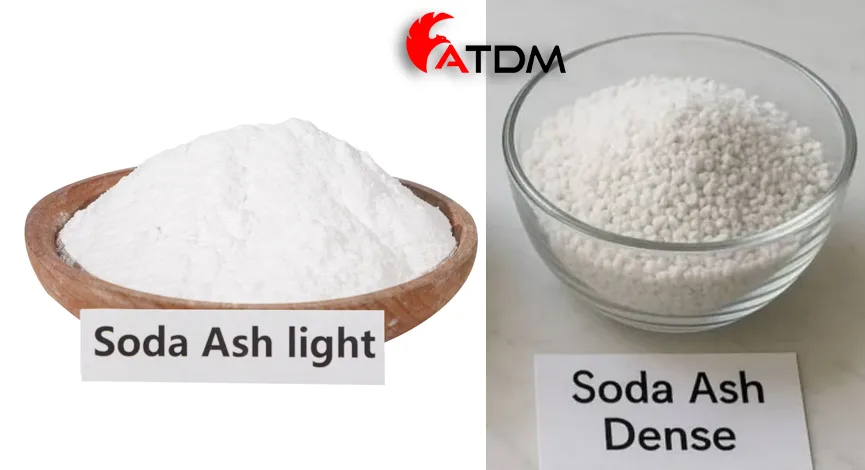
When buyers compare soda ash dense vs light, they usually want one clear answer: which grade fits their process better? Although both grades contain sodium carbonate, they behave differently in storage, handling, dissolving, dosing, and industrial production. Therefore, choosing between dense soda ash and light soda ash affects cost, performance, logistics, and final product quality.
Soda Ash Dense vs Light: Main Difference
The key difference between soda ash dense vs light is bulk density. Soda ash dense has heavier, larger, and more compact particles. As a result, it occupies less space and flows better in many automated systems. On the other hand, soda ash light has finer, lighter, and more porous particles. Therefore, it dissolves faster and works better in applications that need quick reaction or easy mixing.
In simple industrial terms, dense soda ash suits high-volume production lines, while light soda ash suits processes that need faster solubility and flexible blending. However, the best choice always depends on the application, equipment, packing method, and target result.
Table of Contents
ToggleSoda Ash Dense Properties
Manufacturers prefer dense soda ash when they need strong flowability, lower dust, and better storage efficiency. Its compact granules reduce material loss during transfer. Also, dense particles move more smoothly through silos, conveyors, feeders, and pneumatic systems.
Because soda ash dense has higher bulk density, buyers can store more product in the same warehouse space. Moreover, shipping becomes more efficient because dense grade needs fewer bags or less container space for the same weight. For large factories, this advantage can reduce logistics costs.
Dense grade also offers better performance in glass production. Glass plants often choose soda ash dense for glass manufacturing because it mixes well with silica sand and limestone. In addition, its lower dust level improves workplace cleanliness and supports stable batch preparation.
Soda Ash Light Properties
Soda ash light gives manufacturers a different advantage. Since its particles are finer and more porous, it dissolves quickly in water. Consequently, industries that need fast chemical reaction often choose light grade.
Many detergent, cleaning powder, chemical, and water treatment producers prefer light soda ash because it blends easily with other raw materials. Also, its low bulk density helps when manufacturers need a fluffy texture in powdered products.
Although light soda ash creates more dust than dense grade, it still offers strong value in many applications. For example, detergent manufacturers often use soda ash light for detergent powder because it supports cleaning performance, pH control, and powder structure.
Soda Ash Dense vs Light in Glass Industry
The glass industry remains one of the largest users of sodium carbonate. When comparing soda ash dense vs light for glass, dense grade usually wins. It gives better flow, lower dust, easier batching, and more stable mixing.
Glass manufacturers need consistent raw material feeding. Therefore, they often choose dense soda ash for flat glass, container glass, fiberglass, and solar glass. Dense grade reduces segregation in the batch and improves handling in automated systems.
However, some small-scale producers may still use light grade when their equipment supports it. Even so, for large glass plants, soda ash dense normally provides better operational efficiency.
Soda Ash Dense vs Light in Detergent Industry
In detergents, the comparison changes. Soda ash light often becomes the better option because it dissolves faster and blends more easily. Detergent producers value quick solubility, smooth mixing, and good powder texture. Therefore, light soda ash for detergent manufacturing remains a popular choice.
Still, some detergent plants use dense grade when they need lower dust or better flow in bulk systems. So, the right decision depends on the formula. For handwashing powder, laundry powder, dishwashing powder, and industrial cleaners, manufacturers usually test both grades before final selection.
Soda Ash Dense vs Light in Water Treatment
For water treatment, both grades can work well. However, operators usually choose based on dissolving speed and dosing system. Soda ash light dissolves faster, so it suits manual dosing and solution preparation. Meanwhile, soda ash dense works better in automated plants that need smoother feeding and less dust.
In pH adjustment, alkalinity control, and wastewater treatment, consistency matters. Therefore, buyers should check particle size, purity, moisture, and solubility before choosing between sodium carbonate dense vs light.
Soda Ash Dense vs Light in Chemical Production
Chemical manufacturers use both grades in many reactions. Soda ash light works well when the process needs fast dissolution. In contrast, soda ash dense supports controlled feeding, cleaner handling, and bulk storage.
For sodium silicate, sodium bicarbonate, dyes, textiles, paper, and industrial chemicals, process engineers often compare soda ash dense price vs soda ash light price, but they should also compare performance. Sometimes a cheaper grade increases dust, waste, or handling problems. Therefore, total cost matters more than only purchase price.
Particle Size, Bulk Density, and Flowability
When buyers search for difference between soda ash dense and soda ash light, they often focus on particle size and density. Dense grade has larger, harder granules. Light grade has smaller and softer particles.
This difference affects:
- Density and storage volume
- Dust generation during handling
- Dissolving speed in water
- Flowability in equipment
- Mixing behavior with other materials
- Packaging and transport efficiency
Because of these factors, dense grade often performs better in bulk handling, while light grade often performs better in fast-dissolving applications.
Price Comparation
The price of soda ash dense vs light can vary by purity, origin, packaging, shipping terms, order volume, and market demand. Generally, dense grade may cost more because it requires additional processing. However, it can reduce transport and storage costs due to its higher bulk density.
Light grade may offer a lower initial price in some markets. Nevertheless, buyers should calculate total landed cost, not only unit price. For example, dust loss, warehouse space, bag quantity, labor, and dosing efficiency can change the real cost.
How to Choose Between Soda Ash Dense and Light
To choose the right grade, buyers should start with the final application. Choose soda ash dense when you need better flowability, low dust, bulk storage, efficient transport, and glass-grade performance. Choose soda ash light when you need fast dissolution, easy blending, detergent production, chemical reaction, or manual solution preparation.
Also, check product specifications before placing an order. Important details include sodium carbonate purity, bulk density, particle size, chloride level, sulfate level, iron content, moisture, insoluble matter, and packaging type.
ATDM as Soda Ash Supplier
ATDM supplies high-quality soda ash for industrial buyers who need reliable sourcing, consistent specifications, and professional export support. As a supplier of soda ash dense and soda ash light, ATDM can support customers in glass, detergent, chemical, textile, water treatment, and other industrial sectors.
Buyers who compare soda ash dense vs light can contact ATDM to select the best grade based on application, packing needs, delivery terms, and target market. Moreover, ATDM helps customers choose suitable sodium carbonate products for both small and bulk orders.
Final Comparison
In the end, the choice between soda ash dense vs light depends on performance, not only grade name. Dense soda ash offers better handling, higher bulk density, lower dust, and stronger value for glass and large-scale automated systems. Meanwhile, light soda ash offers faster dissolution, easier blending, and strong performance in detergents, chemicals, and water treatment.
Therefore, buyers should match the grade with their production method. When the process needs clean bulk handling, dense grade usually works better. However, when the process needs fast mixing and quick solubility, light grade often becomes the smarter option.


