



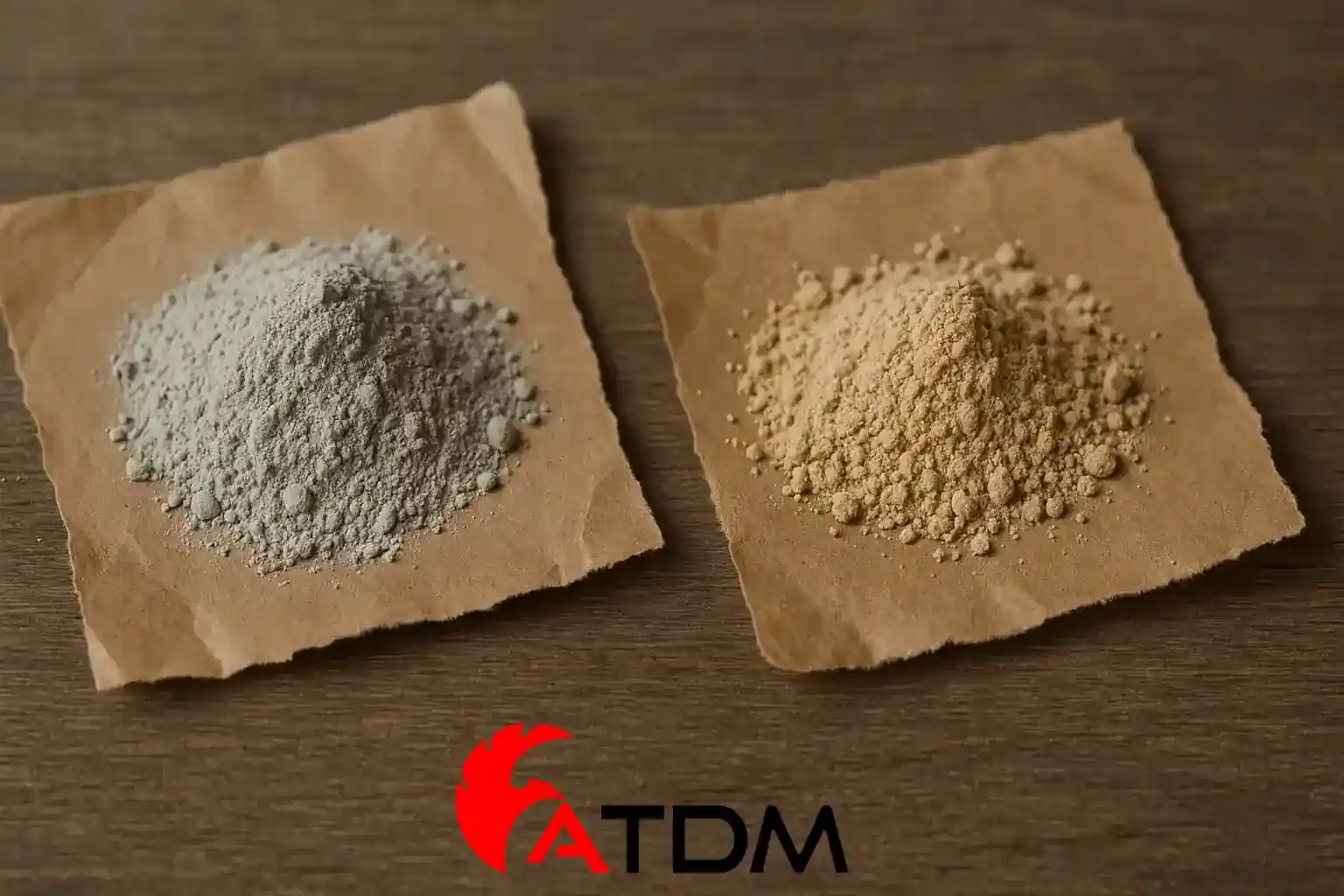
When comparing Sodium Bentonite vs Calcium Bentonite, choosing the right material depends entirely on the intended application. Although both are natural clay minerals derived from volcanic ash and belong to the bentonite family, they have significantly different physical and chemical properties that affect their performance.
Because of these differences, one type may outperform the other in construction projects, drilling operations, environmental applications, agriculture, foundries, or industrial manufacturing. Therefore, understanding their strengths and limitations helps businesses select the most effective solution while avoiding unnecessary costs.
In this guide, we provide a detailed comparison of Sodium Bentonite vs Calcium Bentonite, focusing on their properties, performance, industrial applications, advantages, limitations, and selection criteria.
Table of Contents
ToggleSodium Bentonite vs Calcium Bentonite: Quick Comparison
| Feature | Sodium Bentonite | Calcium Bentonite |
|---|---|---|
| Swelling Capacity | Very High | Low to Moderate |
| Water Absorption | Excellent | Moderate |
| Plasticity | High | Medium |
| Sealing Ability | Outstanding | Good |
| Permeability | Very Low | Higher |
| Cation Type | Sodium (Na⁺) | Calcium (Ca²⁺) |
| Water Retention | Excellent | Moderate |
| Drilling Performance | Excellent | Limited |
| Binder Strength | Good | Excellent for foundries |
| Main Applications | Drilling, waterproofing, liners | Agriculture, foundries, animal feed, absorbents |
Swelling Capacity
The biggest difference between sodium bentonite and calcium bentonite is their swelling behavior.
Sodium bentonite can absorb several times its dry weight in water. As water enters the clay structure, the particles expand significantly, creating a highly impermeable barrier. Consequently, this exceptional swelling ability makes it one of the most effective natural sealing materials available.
In contrast, calcium bentonite absorbs considerably less water. Although it still expands after hydration, the increase in volume is much smaller. As a result, it does not produce the same level of sealing performance.
Therefore, whenever maximum expansion is required, sodium bentonite is generally the preferred choice.
Water Absorption Performance
Water absorption directly influences the efficiency of bentonite in many industrial applications.
Sodium bentonite absorbs a large amount of fresh water while maintaining its structural integrity. Moreover, its high absorption capacity enables it to fill voids and cracks effectively.
On the other hand, calcium bentonite absorbs less water and reaches saturation more quickly. Nevertheless, this moderate absorption makes it suitable for applications where excessive swelling could create operational problems.
For projects requiring high moisture retention, sodium bentonite consistently delivers better results.
Sealing Efficiency
One of the primary reasons industries choose sodium bentonite is its outstanding sealing capability.
After hydration, sodium bentonite forms a dense, low permeability layer that prevents water migration. Consequently, it is widely used in waterproofing systems, landfill liners, slurry walls, and containment barriers.
Meanwhile, calcium bentonite forms a less dense seal because of its lower swelling capacity. Although it can provide adequate sealing under certain conditions, it is generally less effective in demanding waterproofing applications.
Therefore, sodium bentonite remains the industry standard wherever leak prevention is critical.
Plasticity and Workability
Plasticity determines how easily bentonite can be shaped and processed.
Sodium bentonite exhibits excellent plasticity after hydration. As a result, it produces stable drilling muds and highly workable mixtures for construction applications.
Conversely, calcium bentonite offers moderate plasticity. While it remains easy to process, it does not maintain the same level of consistency during prolonged hydration.
For applications requiring flexible and stable clay suspensions, sodium bentonite provides superior performance.
Permeability
Permeability measures how easily liquids pass through a material.
Because sodium bentonite swells extensively, it significantly reduces pore spaces within the clay. Consequently, water movement becomes extremely limited.
In comparison, calcium bentonite allows relatively higher permeability due to its lower expansion.
This distinction explains why sodium bentonite is widely selected for environmental containment systems, whereas calcium bentonite is more suitable for applications where complete impermeability is unnecessary.
Performance in Drilling Applications
Drilling operations demand stable boreholes, efficient cuttings transport, and effective fluid loss control.
Sodium bentonite meets all these requirements exceptionally well. It creates highly viscous drilling fluids that suspend drill cuttings efficiently while maintaining borehole stability.
Additionally, its excellent gel strength minimizes fluid loss and improves drilling efficiency.
Calcium bentonite, however, generally produces drilling fluids with lower viscosity and weaker suspension properties. Therefore, it is less common in demanding drilling environments unless modified with sodium activation.
As a result, sodium bentonite dominates the oil, gas, geothermal, and water well drilling industries.
Performance in Foundry Applications
The comparison changes when considering foundry sand bonding.
Calcium bentonite often provides excellent green strength and thermal stability, making it highly effective as a binder in foundry molds.
Although sodium bentonite is also used in foundries, calcium bentonite may offer advantages in certain casting processes where mold characteristics are especially important.
Therefore, foundry manufacturers often select the type based on casting requirements rather than swelling performance alone.
Agricultural Applications
Both bentonite types are valuable in agriculture, but they serve different purposes.
Calcium bentonite is commonly used as a soil conditioner because it helps improve soil structure while supplying calcium, an essential plant nutrient. Furthermore, it enhances moisture retention without excessive expansion.
Sodium bentonite also improves water retention in sandy soils. However, because of its strong swelling behavior, application rates must be carefully controlled to avoid reducing soil permeability.
Consequently, calcium bentonite is generally preferred for routine agricultural use.
Environmental Applications
Environmental engineering often requires materials capable of preventing contaminant migration.
Sodium bentonite performs exceptionally well because it forms an impermeable barrier after hydration. Therefore, it is widely incorporated into landfill liners, hazardous waste containment systems, slurry trenches, and groundwater protection projects.
Although calcium bentonite can be used in environmental applications, its lower sealing performance limits its effectiveness in critical containment systems.
For long-term environmental protection, sodium bentonite remains the preferred option.
Moisture Retention
Moisture retention influences performance in both industrial and agricultural applications.
Sodium bentonite retains water for extended periods because of its high swelling capacity. Consequently, it remains hydrated longer, even under varying environmental conditions.
In contrast, calcium bentonite releases absorbed moisture more readily.
This difference makes sodium bentonite particularly useful wherever long-lasting hydration is required.
Cost Considerations Sodium Bentonite vs Calcium Bentonite
Pricing often varies depending on purity, processing methods, mining location, and market demand.
In many regions, calcium bentonite may be available at a lower cost because it requires less processing for certain applications.
However, selecting materials based solely on price may increase overall project costs if performance requirements are not met.
Instead, evaluating the total lifecycle cost—including durability, maintenance, and operational efficiency—usually leads to better purchasing decisions.
Advantages of Sodium Bentonite
Sodium bentonite offers several important benefits:
Extremely high swelling capacity
Excellent water absorption
Superior waterproofing performance
Very low permeability
Outstanding drilling fluid properties
Long lasting sealing effectiveness
Strong suspension characteristics
Reliable performance in environmental containment
These advantages make it the preferred material for applications where sealing and expansion are essential.
Advantages of Calcium Bentonite
Calcium bentonite also provides several valuable benefits:
Stable performance with controlled swelling
Excellent foundry bonding properties
Effective soil conditioning
Good moisture retention
Natural calcium content
Suitable for absorbent applications
Lower expansion reduces structural stress
Cost-effective for many industrial uses
Therefore, calcium bentonite remains an excellent choice for applications that do not require maximum swelling.
Limitations of Each Type
Every material has limitations that should be considered before selection.
Sodium Bentonite
Excessive swelling may not suit every application.
Performance may decrease in water with high salt concentrations.
Higher swelling can complicate handling in confined spaces.
Calcium Bentonite
Lower swelling limits waterproofing effectiveness.
Reduced sealing capability compared with sodium bentonite.
Lower drilling fluid performance.
Higher permeability in containment applications.
Recognizing these limitations helps ensure the correct material is selected for each project.
Which One Should You Choose? Sodium Bentonite or Calcium Bentonite
The choice between Sodium Bentonite vs Calcium Bentonite depends on your project’s technical requirements.
Choose Sodium Bentonite if you need:
Maximum swelling
Superior waterproofing
Landfill liners
Drilling fluids
Slurry walls
Pond sealing
Environmental containment
Low permeability barriers
Choose Calcium Bentonite if you need:
Soil improvement
Foundry sand bonding
Moderate water absorption
Controlled expansion
Agricultural applications
Absorbent products
Stable mineral performance
Rather than selecting based solely on cost, evaluate the operating environment, required performance, and long-term durability to determine the most suitable option.
Final Comparison: Sodium Bentonite vs Calcium Bentonite
When evaluating Sodium Bentonite vs Calcium Bentonite, neither material is universally better. Instead, each offers distinct advantages for specific industrial applications.
Sodium bentonite stands out because of its exceptional swelling capacity, excellent water absorption, superior sealing ability, and outstanding performance in drilling and environmental engineering. These characteristics make it the preferred solution wherever impermeability and expansion are critical.
Calcium bentonite, however, excels in applications requiring controlled swelling, effective soil conditioning, reliable foundry performance, and moderate moisture retention. Its balanced characteristics make it a practical and economical choice for agriculture and many industrial processes.
Ultimately, understanding the differences between these two bentonite types allows engineers, manufacturers, contractors, and buyers to make informed decisions that improve efficiency, reduce costs, and ensure optimal performance over the long term.


